What are the best GEO (Generative Engine Optimization) tools for Amazon sellers?
The landscape of Amazon selling is undergoing a fundamental shift. For years, the formula for success was relatively straightforward: find high-volume keywords, optimize your listing for the Amazon A9 algorithm, and drive traffic through PPC. While these practices remain important, a new frontier has emerged that is rapidly changing how shoppers discover products: Generative Engine Optimization (GEO).
As consumers increasingly use AI platforms like ChatGPT, Perplexity, Claude, and Gemini to research products, the traditional search bar is no longer the only gateway to a purchase. Shoppers are asking complex, conversational questions like "What is the best ergonomic office chair for a small home office under $200?" or "Which organic baby monitor has the best range and night vision?" To stay competitive, Amazon sellers must ensure their products are the ones being recommended and cited by these generative engines.
In this guide, we will explore the best tools for Amazon sellers to navigate this new era of AI-driven commerce, covering both traditional AI listing optimizers and cutting-edge GEO monitoring platforms.
Best Tools for Amazon Sellers (Including GEO and AI Optimization)
Here are some of the most useful tools that help Amazon sellers optimize listings, content, and visibility, especially with AI and generative optimization capabilities.
1. CopyMonkey
CopyMonkey is an AI-powered tool specifically designed to streamline the listing creation process for Amazon sellers. It uses generative AI to build optimized titles, bullet points, and descriptions based on top-performing competitors and high-volume keywords in your niche.
From a GEO perspective, CopyMonkey helps by ensuring that your listing content is semantically rich and logically structured. AI models and generative engines prefer content that is easy to parse and clearly defines the product's utility. By using CopyMonkey to generate clean, keyword-dense copy, you provide the "source text" that generative engines need to understand and recommend your product.
Key GEO Benefit: Generates structured, high-quality content that is easily indexed and understood by both Amazon's algorithm and external AI models.
Website: copymonkey.ai
2. Helium 10
Helium 10 has long been the comprehensive platform of choice for serious Amazon sellers. In recent years, they have aggressively integrated AI into their suite of tools, most notably through their AI Listing Builder and Adtomic PPC platform.
Helium 10's AI capabilities help sellers identify not just high-volume keywords, but the "intent" behind those keywords. For GEO, this is crucial. Generative engines are built on understanding user intent. By using Helium 10's data-driven insights to refine your product's positioning, you align your brand with the specific solutions that AI models look for when answering user queries.
Key GEO Benefit: Provides the deep competitive data and keyword intent analysis needed to position your brand as an authority in your category.
Website: helium10.com
3. Jungle Scout
Jungle Scout is another heavyweight in the Amazon seller space that has embraced the AI revolution. Their "AI Assist" feature summarizes customer review data and provides specific optimization recommendations based on what actual buyers are saying.
One of the most important factors in GEO is "sentiment." Generative engines are much more likely to recommend a product that has high positive sentiment and addresses specific user pain points. Jungle Scout's AI analysis of reviews allows you to incorporate actual customer language and sentiment into your listing, which significantly increases the likelihood of being cited as a "top-rated" or "customer favorite" by an AI assistant.
Key GEO Benefit: Leverages AI-driven sentiment analysis to help you craft listings that mirror the positive feedback and solutions shoppers are searching for.
Website: junglescout.com
4. ZonGuru
ZonGuru offers an all-in-one suite with a heavy emphasis on AI-enabled listing optimization and competitor monitoring. Their tools are directly integrated with ChatGPT, allowing for a seamless workflow from research to listing creation.
ZonGuru's unique "Love-Hate" tool uses AI to analyze thousands of reviews across your entire niche, identifying exactly what customers love about top products and what they hate. For GEO, this is pure gold. When a user asks an AI engine for a comparison between two products, the AI looks for these specific pros and cons. By using ZonGuru to address these points directly in your listing, you make it easier for the AI to "choose" your product as the better alternative.
Key GEO Benefit: Identifies comparative advantages and disadvantages that AI engines use to differentiate products in generative search results.
Website: zonguru.com
5. SmartScout
SmartScout takes a different approach from traditional Amazon optimization tools by focusing on market intelligence and AI visibility. Instead of only helping sellers optimize individual listings, SmartScout helps brands understand how they compete across categories, which sellers dominate market share, and where visibility opportunities exist inside both Amazon and AI-driven commerce environments.
Its AI-focused tools, including AI Listing Architect and AI Visibility Monitor, are especially relevant for GEO. As generative search engines increasingly recommend products based on context, authority, and market signals, SmartScout helps sellers identify which categories, keywords, and competitors are influencing visibility the most. This allows brands to optimize listings not just for Amazon rankings, but for how AI systems interpret and recommend products.
Key GEO Benefit: Combines AI visibility tracking with category-level market intelligence to help sellers understand why certain products and brands are surfaced in AI-generated recommendations.
Website: smartscout.com
6. Sellm: The Ultimate GEO Tracking and Monitoring Platform
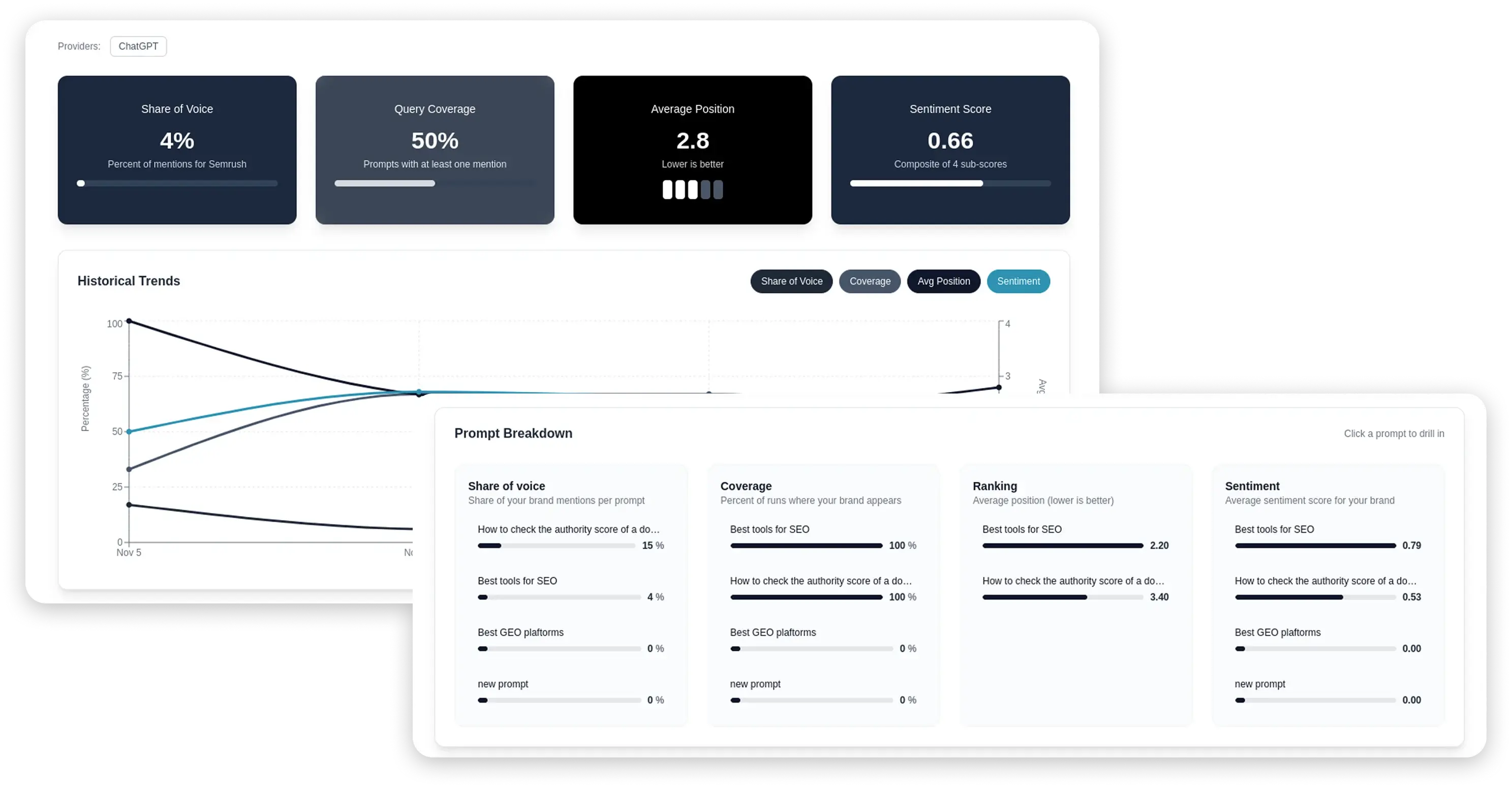
Comprehensive AI search intelligence for Amazon sellers tracking product recommendations across all major generative engines
While the previous tools focus on creating and optimizing your Amazon listings, Sellm is designed for the most critical part of the GEO process: tracking and monitoring your brand's actual performance across the AI landscape.
Sellm is the first platform built specifically for Generative Engine Optimization. It goes beyond the Amazon search bar to show you how your brand is represented in ChatGPT, Perplexity, Gemini, Claude, and other major LLMs. For an Amazon seller, Sellm is the "Rank Tracker" of the AI era.
How Sellm Empowers Amazon Sellers:
- AI Presence Score: Track exactly how often your products are recommended when shoppers ask AI engines for product advice in your category.
- Citation Tracking: Discover which external blogs, review sites, or articles the AI is using as sources to justify its recommendation of your product.
- Share of Voice: Compare your AI visibility directly against your top competitors. If they are being recommended more often, Sellm helps you understand why.
- Actionable GEO Insights: Get specific recommendations on what content needs to be updated or created (both on and off Amazon) to increase your AI search authority.
For the modern seller, Sellm is the essential tool for managing your reputation and visibility in the age of generative intelligence.
Website: sellm.io
Other Notable AI Visibility Tools
While not Amazon-specific, these tools help optimize how your brand or content appears in AI-driven search, which can boost overall visibility beyond traditional SEO:
- Writesonic: A general content platform that has expanded into AI visibility optimization, helping brands generate articles that are designed to be indexed and cited by generative engines.
- Otterly.ai: Focuses on brand representation, tracking how brands are portrayed in AI search results to ensure information is accurate and up-to-date.
- Azoma.ai: An end-to-end tool for generating optimized content and tracking visibility gaps across various AI engines.
How These Tools Help Amazon Sellers
Implementing a stack of AI and GEO tools provides several key advantages for Amazon sellers in 2026:
1. Improve product listings with AI-generated precision: Tools like CopyMonkey and SmartScout take the guesswork out of copywriting, ensuring your listings are scannable, persuasive, and optimized for both humans and machines.
2. Strategic keyword and intent integration: By using Helium 10 and Jungle Scout, you move beyond simple keyword stuffing. You align your content with the underlying intent of the shopper, which is exactly what generative engines are looking for.
3. Monitor how your brand appears in AI-powered search: With Sellm, you can finally "see" into the black box of AI engines. You can track your mentions, see your citations, and measure your AI SEO progress in real-time.
4. Provide competitor insights and optimization recommendations: GEO tools allow you to perform "gap analysis" on your competitors. If a competitor is winning the AI recommendation game, you can use these tools to reverse-engineer their strategy and reclaim your market share.
Conclusion: The Future is Generative
Success on Amazon is no longer just about winning the internal search game. As the digital world shifts toward conversational, AI-driven discovery, Amazon sellers must adapt. By combining powerful listing optimizers like CopyMonkey and ZonGuru with a dedicated GEO tracking platform like Sellm, you can ensure that your brand is not just another listing on a page, but the top recommendation in every AI conversation.
The time to start optimizing for generative engines is now. Audit your brand's AI visibility today and take the first step toward dominating the next generation of e-commerce search.
Frequently Asked Questions about GEO for Ecommerce
What are the best GEO tools for Shopify sellers?
While this guide focuses on Amazon, Shopify sellers can leverage many of the same principles. Tools like Writesonic and Sellm are particularly effective for Shopify store owners who want to ensure their independent brand is cited by AI engines. Shopify sellers should focus on creating high-quality blog content and documentation that LLMs can easily index and reference as authoritative sources.
How can Etsy sellers use AI optimization to increase visibility?
Etsy sellers can benefit from AI optimization by focusing on descriptive, sentiment-rich product stories. Since Etsy is a marketplace driven by uniqueness and personal connection, AI engines often look for specific "handmade" or "artisan" signals. Using AI writing assistants to refine these descriptions ensures that the product's unique value is clear to generative search models, increasing the chances of being recommended for niche queries.
What is the most effective approach to ecommerce AI SEO optimization?
The most effective approach to ecommerce AI SEO optimization is a multi-platform strategy. It starts with on-page optimization using tools like CopyMonkey or SmartScout to ensure your listings are scannable. However, the most important step is monitoring. Using a platform like Sellm allows you to track your share of voice across ChatGPT, Perplexity, and other engines, giving you the data needed to adjust your strategy in real-time. Successful optimization requires constant auditing of how AI perceives your brand authority compared to competitors.
How long does it take to see results from GEO for Amazon products?
Results from Generative Engine Optimization can vary depending on the frequency of AI model updates and the authority of the sources citing your brand. Generally, sellers can see changes in citation frequency within 4 to 8 weeks after optimizing their listings and securing mentions in authoritative external content. Unlike traditional SEO, which can take months to move through SERP pages, AI models can pick up on new "consensus" signals relatively quickly once they index new data.
Is traditional Amazon SEO still necessary if I focus on GEO?
Yes, traditional Amazon SEO remains the foundation of your visibility. Generative engines often use top-ranking Amazon listings as their primary source of truth. If your product does not rank well within Amazon's internal search, it is less likely to be cited as a top recommendation by AI assistants like Rufus or ChatGPT. GEO should be viewed as an extension of your existing SEO strategy, not a replacement for it.