How to Find Content Gaps and Keyword Difficulty in the AI SEO Era
The traditional SEO playbook is being rewritten. In the age of generative search, success isn't just about ranking #1 on a SERP; it's about becoming the definitive source that AI engines like ChatGPT, Perplexity, and Claude cite to answer user queries.
But how do you know which "keywords" are worth pursuing when the output is a conversational response rather than a list of links? The answer lies in understanding Content Gaps and AI Keyword Difficulty. At Sellm, we've developed a precise pipeline to help you navigate this transition and dominate the AI search landscape.
The AI SEO Pipeline: From Data to Citations
Finding gaps in the AI's knowledge base requires a shift in mindset. You are no longer looking for "low competition" keywords in the traditional sense; you are looking for unanswered questions and under-optimized authority signals. Here is our 4-step methodology:
Step 1: Add the Prompts into Sellm
Start by identifying the conversational queries (prompts) your target audience is using. These aren't just "buy ergonomic chair" but rather "What are the best ergonomic chairs for people with lower back pain working from home?". By feeding these prompts into Sellm, you begin to see exactly how AI models perceive your niche and which players are currently winning the citation game.
Step 2: Analyze the Prompt Difficulty
In traditional SEO, difficulty is mostly about backlinks. In AI SEO, difficulty is two-dimensional. We provide two critical scores to help you assess the challenge:
- Domain Authority (DA) Score: Measures the traditional SEO strength (backlinks, ref domains) of the current winners.
- AI SEO Alignment Score: Measures how well the existing content "fits" the AI's response logic.
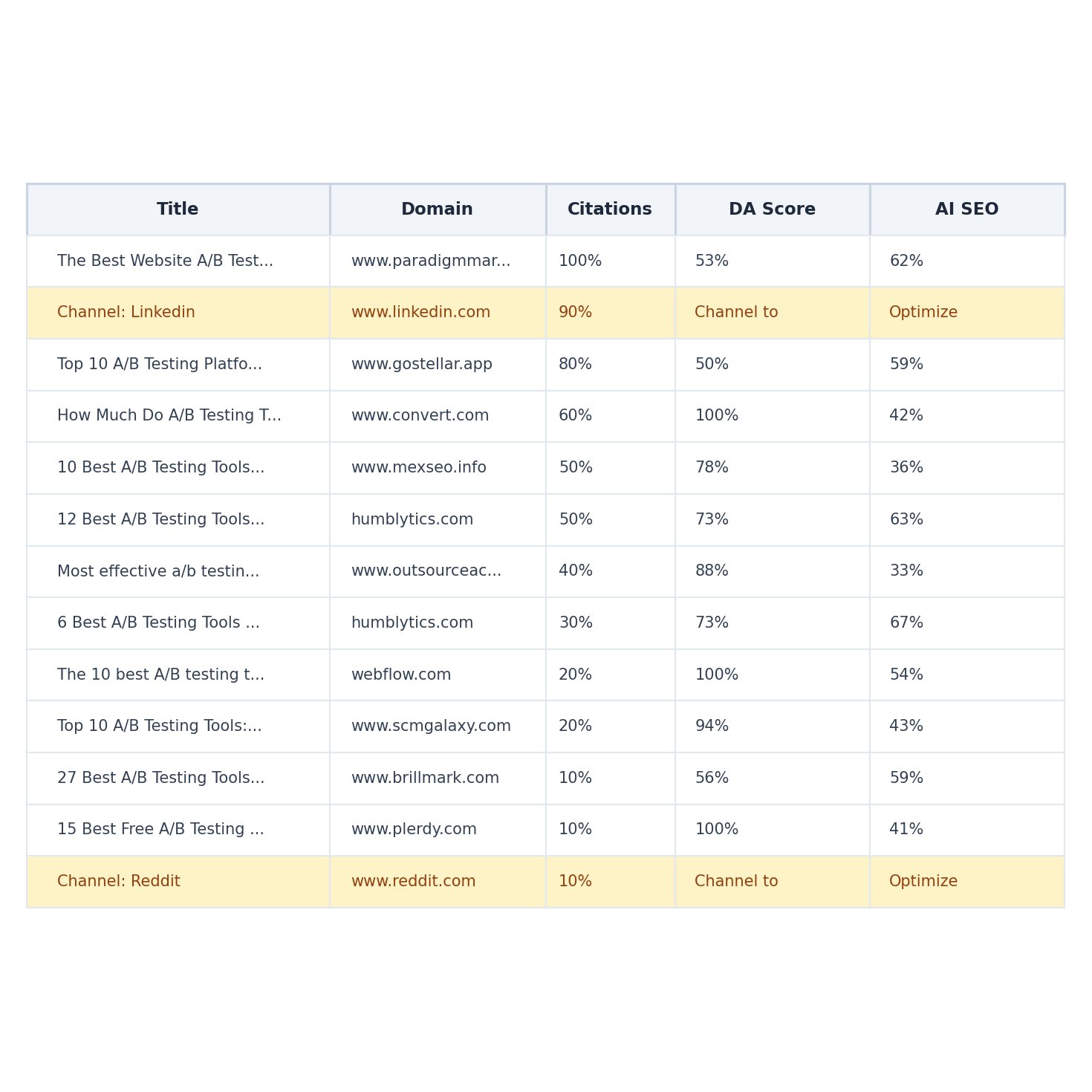
The Sellm Analysis Table: Identifying the balance between traditional authority and AI-specific optimization.
As seen in the analysis table above, you might find "Channels" like Reddit or LinkedIn citing content with high frequency but low AI SEO alignment. These are your biggest opportunities: high-traffic gaps where the current source is a "Channel to Optimize" rather than a perfectly tailored article.
Step 3: Prioritize Content with Low KWD First
Just like in traditional SEO, you want to pick the low-hanging fruit. Prioritize prompts where the AI SEO Alignment Score of the top results is low. This indicates that the AI is struggling to find a "perfect" answer and is settling for the best available option. By creating content that perfectly mirrors the AI's preferred structure and intent, you can leapfrog established domains that may have higher DA but lower relevance to the specific prompt.
Step 4: Achieve Content-Answer Fit
The "Content-Answer Fit" is the holy grail of GEO (Generative Engine Optimization). It's not enough to cover a topic; you must answer the specific sub-questions the AI is trying to address. This is where you perform a deep Content Gap Analysis.
Using our Question Coverage Matrix, you can see exactly which parts of a query are being left unanswered by the current citations.
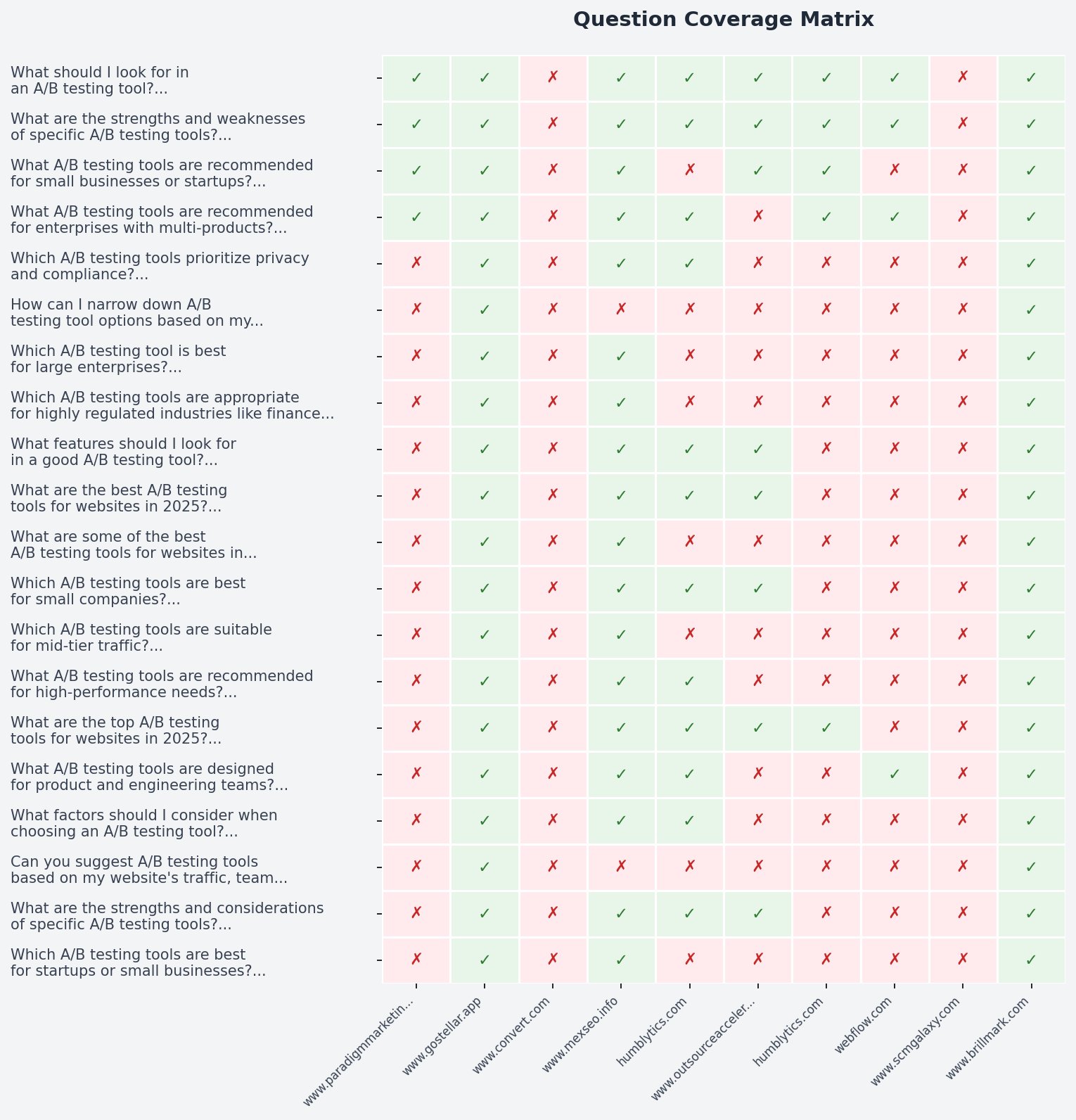
The Question Coverage Matrix: Mapping where competitors fail to answer critical sub-questions.
If the matrix shows a column of "X" marks for a specific set of questions, that is your content gap. By creating an article that specifically targets those missing checkmarks, you provide the AI with the missing piece of the puzzle, significantly increasing your chances of becoming a primary citation.
Conclusion: Data-Driven GEO
AI SEO isn't a guessing game. It's a structured process of identifying where AI engines are currently "settling" for mediocre answers and providing them with superior, well-structured data. By following the Sellm pipeline-adding prompts, analyzing difficulty, prioritizing gaps, and ensuring content-answer fit-you transform your SEO strategy from a reactive struggle to a proactive dominance of the generative era.
Ready to find your gaps? Start your first AI SEO Audit with Sellm today.